Post-frenectomy wound care is finished…Now what?
Once wound care is finished after a frenectomy, the focus can shift from structured healing work to playful oral therapy that helps your baby explore their new tongue mobility in a more relaxed way. This stage matters because babies still need practice to integrate tongue movement into feeding, soothing, and early oral development, even after the wound has healed.
Make it playful
Oral therapy after wound care should feel more like connection and sensory play than a set of stressful exercises. Gentle face-to-face play, singing, exaggerated mouth movements, lip smacks, blowing raspberries, and letting your baby watch your face can all support oral awareness in an interactive way.
You can also use short moments during nappy changes, on your lap, or after a calm feed rather than setting up a separate “therapy session.” Babies often respond best during quiet alert periods, and it is better to stop than push through distress.
Use simple tools
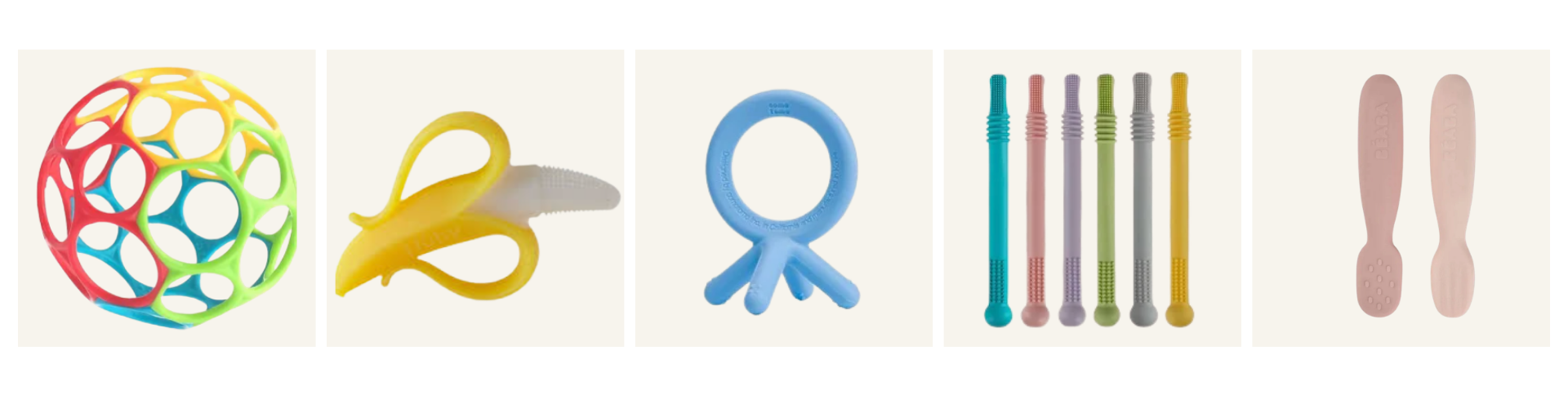
A few easy, baby-friendly tools can support hands-to-mouth play, tongue exploration, gum awareness, and early jaw strength. For babies under 6 months, the most useful tools are usually soft, lightweight, textured, and easy to hold.
Helpful options include:
O Ball or similar graspable teether ball, great for midline play and tongue exploration.
Nuby banana toothbrush or a soft silicone training toothbrush, useful for gum input and forward tongue play.
Comotomo-style teethers, fruit/star teethers, or other silicone teethers with short textured extensions for chewing and mouthing.
Teething tubes, bunny-style teethers, or other short-projection teethers that encourage chewing, lateral tongue movement, and mouth exploration.
Pre-spoons or textured infant spoon handles for babies closer to 4 to 6 months who are beginning to show readiness for mouthing and early feeding exploration.
Soft crinkle toys or sensory cloth toys with tags and different textures, which support hand-mouth coordination and sensory curiosity even if they are not strictly oral tools.
Try gentle oromotor play
Once wound care is complete, the goal is to support function, not force movement. The most useful patterns to encourage are tongue extension, lateralisation, suction, rhythmic jaw movement, and tolerance of touch in and around the mouth.
Simple play-based ideas include:
Let your baby mouth their own hands, an O Ball, or a textured teether to support natural tongue and jaw activity.
Gently move a clean finger along the gums from side to side and let the tongue follow for lateralisation.
Offer a clean finger to suck and use a very gentle “tug of war” to support suction and tongue cupping.
Use a banana toothbrush or soft silicone brush for gentle gum massage and oral sensory input.
Encourage playful lip and cheek awareness with tapping, stroking, or silly sounds rather than repetitive forceful drills.
Why it matters
A frenectomy can improve mobility, but babies still need time and repetition to learn how to use that new range in functional ways. Without that integration, some infants may continue using old sucking or feeding patterns even when the restriction has been released.
Play-based oral therapy can help support:
Better latch or bottle seal.
More coordinated sucking and swallowing.
Improved tongue awareness and movement variety.
Stronger hand-to-mouth skills, which are part of normal 0 to 6 month development.
A more positive emotional association with touch around the mouth after wound care.
What to avoid and how long
Avoid anything that feels forceful, prolonged, or overwhelming once the wound care stage has ended. It is also best to avoid long, narrow tools that can be pushed too far back, and very firm toys designed for older babies with stronger chewing skills.
Keep oral play short and frequent, usually around 1 to 2 minutes at a time, a few times a day, during calm alert windows. Many babies benefit from continuing this playful oral work for several weeks or even months, depending on feeding patterns, tension, coordination, and whether they still seem to rely on compensations.
A simple way to explain it to parents is this: wound care helps healing, but oral play helps your baby learn what to do with their mouth afterwards. This is where function becomes integrated through repetition, safety, and play.
Loved this post? Pin the graphic!

This article is general information only and is not a substitute for personalised medical or allied health advice. Please speak with your GP, MCH nurse or healthcare provider about your baby’s specific situation.
Related Posts:




Learn how to differentiate between colic and reflux symptoms in 4 simple steps.
If you have been told your baby has a tongue tie, anterior restriction or a deeper submucosal restriction, you may be trying to make sense of a difficult decision.
Perhaps feeding has felt hard from the beginning. Your baby may click, leak milk, lose their latch, pull off crying, gulp, cough, swallow air, feed for long periods, become stiff through their body or seem uncomfortable after feeds. You may have sore nipples, damaged nipples, low supply, oversupply or concerns about whether your baby is transferring milk efficiently.